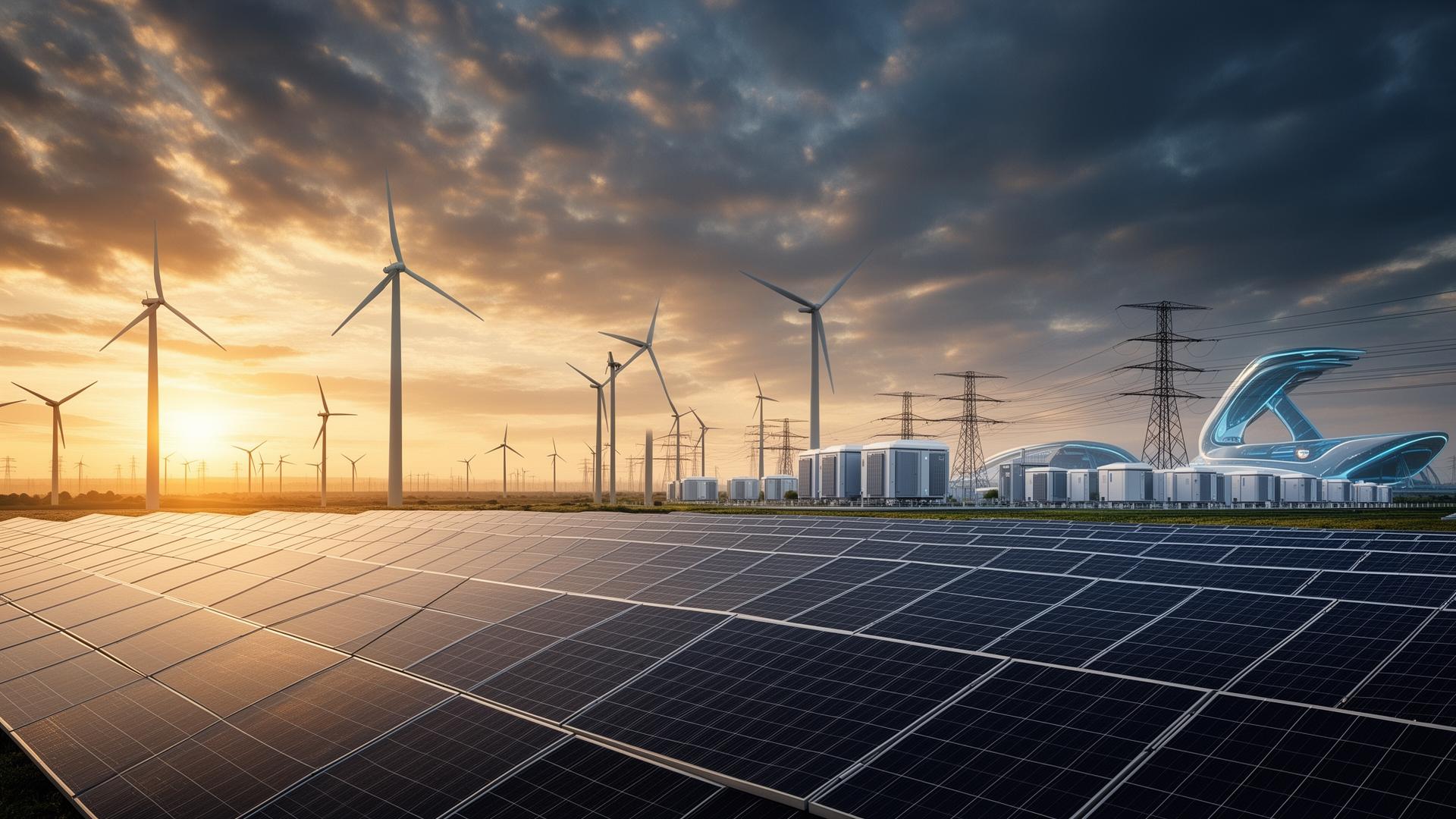
The renewable energy sector in 2026 is navigating a paradox: achieving historic milestones in generation capacity while confronting the most complex deployment challenges in two decades. For the first time, wind and solar will supply over 36% of global electricity—surpassing coal—yet market participants face grid constraints, policy pivots in major economies, and explosive AI-driven electricity demand that threatens to outpace infrastructure readiness.
This comprehensive analysis examines the forces reshaping renewable energy markets in 2026, drawing on IEA projections, BloombergNEF outlooks, commodity market dynamics, and social media sentiment analysis.
Executive Summary: The 2026 Renewable Energy Landscape
Market Signal Dashboard
Global Generation Growth
+20%
Solar & wind power generation projected to grow 20% in 2026 under IEA STEPS scenario
First Solar Decline
649 GW
Global installations down from 655 GW—first decline in over two decades
China Policy Pivot
-100 GW
Chinese additions expected to fall from 300 GW to 200 GW annually
AI Demand Surge
+3.7%
Global electricity demand growth accelerating from 3.3% to 3.7%
US Tariff Barriers
350-670%
Solar tariffs on Cambodia, Thailand, Vietnam disrupting supply chains
Battery Storage Surge
+31%/yr
BESS capacity growing 31% annually through 2030
The convergence of AI data center expansion, extreme weather events exposing grid vulnerabilities, and commodity price volatility is fundamentally altering investment calculus across the sector. Natural gas prices surged over 70% in a single week of January 2026—the largest weekly advance since 1990—while precious metals used in renewable infrastructure (silver up 234% YoY, copper at $5.82/lb) signal both supply chain pressure and investor hedging behavior.
China's Policy Pivot: The End of Guaranteed Returns
China's renewable energy market—which accounts for nearly half of global additions—underwent a structural transformation in 2025 that will define deployment patterns through 2026 and beyond. The removal of guaranteed rates of return and shift to competitive market-based auctions alarmed investors, causing installations to decelerate in the second half of 2025 despite record-setting additions in the first half.
2025 Peak
~300 GW
Record installations before policy shift
2026 Projection
~200 GW
Expected after competitive auction transition
Global Gap
-100 GW
Cannot be offset by other regions
For developers operating in China, the new paradigm demands enhanced cost efficiency, innovation in project structuring, and strategic optimization of bidding strategies. Despite policy headwinds, China maintains absolute manufacturing advantages in solar panel, wind turbine, and battery storage production—currently supplying 98% of EU solar panel imports.
United States: Policy Uncertainty Meets AI Demand Surge
The U.S. renewable energy market faces contradictory forces in 2026: unprecedented electricity demand growth driven by AI infrastructure colliding with hostile federal energy policy and escalating tariff barriers.
🚀 Demand Drivers
- AI Data Centers: Strongest 4-year demand growth since 2000
- Industrial Electrification: Manufacturing shifting from gas to electric
- Heat Pump Adoption: Residential heating transformation
- Corporate PPAs: Tech giants securing 24/7 carbon-free energy
🛑 Supply Constraints
- Solar Tariffs: 350-670% on Southeast Asian imports
- Steel Tariffs: 50% on wind towers and nacelles
- Projects at Risk: 519 projects (117 GW) threatened
- Offshore Cancellations: High-profile projects abandoned
For renewable energy developers, this demand surge transforms the value proposition from "cheap megawatt-hours" to "deliverable megawatt-hours with grid certainty." Interconnection queue position, commercial operation date confidence intervals, and ability to provide shaped/firmed power are becoming primary differentiators.
Europe: Grid Constraints as the Primary Bottleneck
Transmission
Limited interconnection between member states restricting deployment
Grid Upgrades
Physical infrastructure requires multi-year timelines lagging project development
Supply Chain
NZIA implementation uneven; Italy first to ban Chinese components in auctions
Solar Deployment
Strong auction participation and competitive pricing across Southern Europe
Offshore Wind
North Sea and Baltic leadership with 50% generation growth projected
"The debtor is 'reviewing the invoice'… since last quarter."
— Every AR team, ever
Speed multiplier:
Cases with partial payment history + clean documentation resolve 3× faster on average.
Battery Storage: The Critical Enabler
Battery energy storage systems (BESS) have transitioned from optional enhancement to deployment prerequisite in many markets experiencing grid congestion. More than ever, the industry recognizes BESS as essential infrastructure for sustaining solar and wind growth.
Cost Disruption
Turnkey BESS costs fell 61% from 2020-2025
PROVENChina Dominance
46% of global BESS capacity in 2026
SCALINGUS Attachment
Storage rates rising from 26% to 50%+ by 2030
GROWINGTech Evolution
LFP dominates; sodium-based gaining traction
EMERGINGDuration Gap
4-hour systems insufficient for seasonal balancing
CHALLENGELithium iron phosphate (LFP) batteries dominate BESS applications due to longer cycle life and lower costs. However, current systems provide only four hours of discharge duration—insufficient for seasonal balancing or extended grid support. Sodium-based battery development is accelerating, likely reaching mid-single-digit market share by 2030.
Commodity Market Volatility: The Macro Context
Renewable energy markets in January 2026 are operating within the most volatile commodity price environment since 2022, creating both opportunities and risks for project economics.
Commodity Price Signals
Natural Gas Surge
+70%
Largest weekly advance since 1990 (Winter Storm Fern)
Gold Rally
$4,997/oz
Up 80% year-over-year as safe-haven demand surges
Silver Breakout
$180/oz
Up 234% YoY—45-year breakout on solar PV demand
Copper Deficit
$5.82/lb
330,000 ton deficit forecast; $12,500/ton peak expected
Oil Oversupply
$55/bbl
"Year of the Glut"—3.85M bpd surplus pushing prices down
Winter Storm Impact
822K+
Customers without power; 16,400+ flights canceled
For renewable energy stakeholders, this volatility reinforces several strategic imperatives: domestic wind and solar reduce exposure to fossil fuel price shocks, extreme weather highlights the need for distributed generation and storage, and projects with hybrid configurations command premium valuations.
Regional Growth Forecasts: Where Capital Will Flow
China
+94% Solar
Strongest growth despite near-term slowdown; 50% wind growth through 2030
Europe
+50% Wind
North Sea/Baltic leadership; energy independence priority post-Ukraine
United States
+19% Wind
Bifurcated: strong solar, weakest wind growth due to policy uncertainty
India
Fastest Growth
Strong policy support, competitive auctions, rising economic demand
Investment Themes: Where Capital Is Flowing
Infrastructure Over Generation
- Transmission infrastructure premium valuations
- Storage systems unlocking deployment
- Grid modernization creating returns asymmetry
Vertical Integration
- Equipment manufacturing + development + asset management
- Greater resilience to tariff volatility
- Longi, Trina Solar, Goldwind as exemplars
Corporate PPA Focus
- Investment-grade tech offtakers preferred
- Lower cost of capital for secured projects
- 24/7 CFE matching requirements
Hybrid Solutions
- Solar-plus-storage displacing single-tech
- Superior capacity factors
- Grid services revenue stacking
Materials Plays
- Copper mining and refining
- Silver production for solar PV
- Battery materials processing
Risk Factors and Downside Scenarios
⚠️ Key Risk Factors for 2026
Geopolitical Escalation
Full-blown trade war over critical minerals could fragment supply chains and drive significant cost inflation
Interest Rate Persistence
Capital-intensive projects with long-duration cash flows sensitive to higher-for-longer rates
Grid Constraint Severity
Curtailment could reach economically prohibitive levels, stalling deployment in high-penetration regions
AI Demand Disappointment
If efficiency gains reduce data center intensity faster than expected, demand surge may not materialize
Policy Reversal
Elimination of tax incentives or rollback of mandates could undermine project economics
Strategic Positioning: From Generic to Specific
The renewable energy sector in 2026 sits between "crowded" and "jaded" market stages. Generic sustainability claims fail to differentiate. Success requires demonstrating specific mechanisms backed by proof points.
The questions that matter are no longer "Is renewable energy viable?" but rather "Can you deliver grid-connected, firmed capacity on schedule and on budget?"
Frequently Asked Questions
5 Questions Answered
Click to expand answers

Elena Vasquez
Legal Affairs Director
Elena leads our legal escalation team with expertise in multi-jurisdictional enforcement and commercial litigation strategy.