
"The Money Is in the System." Here's How to Check.
"Payment sent" isn't evidence. A real cross-border transfer carries a reference any bank can check. What to ask for, and what a fake confirmation looks like.
3 min readSep 30, 2026
ReadMunich. A very private club, where the new doorman is Big Terry. House rule number one, engraved on the wall: never pay on time.
Konstantin von Albrecht chairs Feinkost Albrecht GmbH, fourteen delis in Munich, and pays his suppliers in year two. Ana Ferrer runs a family olive-oil business in Tarragona. She is owed €62,000, and she has read the house rules too.
Trick one: "We never received it." Counter: signed proof of delivery, and an invoice that carries the customer's PO number.
Trick two: "Next payment run." Counter: ask for the date, in writing. A dated promise is evidence.
Trick three: "The oil was cloudy." Counter: a first complaint on day 58, after goods were received in good condition, is a stall, not a dispute.
Trick four: "We can wait." Counter: know the limitation period (in Germany, three years counted from the end of the year) and act well before it ends.
Then Ana stopped arguing and filed a European Payment Order: one form, one court in Berlin, for uncontested cross-border claims inside the EU. No hearing. The debtor has 30 days to object. Konstantin was busy. The house rules were amended, and Ana was paid in full on day 74.
Ana's rules: 1. Paper trail before you ship. 2. Get the payment date in writing. 3. A late complaint is a stall. 4. Watch the limitation clock. 5. Cross-border in the EU? File the EPO.
A Collecty film. © Collecty, www.cllcty.com. Reproduction without permission is not allowed. All characters are fictional. This film is general information, not legal advice.
A step-by-step guide to the European order for payment procedure: who can use it, which court to file with, the 30-day objection window, and how to enforce the order in 26 EU countries.
You delivered the work. You shipped the goods. The invoice is 90 days overdue, and your client is in another country. They stopped responding. Here is what actually changes once the debt crosses a border — and what to do next.
Germany pays net 30 + 8 days late. Italy agrees net 60, pays 48 days beyond that. China: add 55 days to whatever you agreed. The real payment behaviour data, country by country.
Germany: 3 years. UK: 6 years. UAE: 15 years. Once the limitation period expires, your claim is unenforceable. A 58-second animated briefing with the real deadlines by country.
"Payment sent" isn't evidence. A real cross-border transfer carries a reference any bank can check. What to ask for, and what a fake confirmation looks like.

In Spain, Italy and the Netherlands, a written demand restarts the limitation clock. In France, Germany and England it does nothing. Here's how to tell.
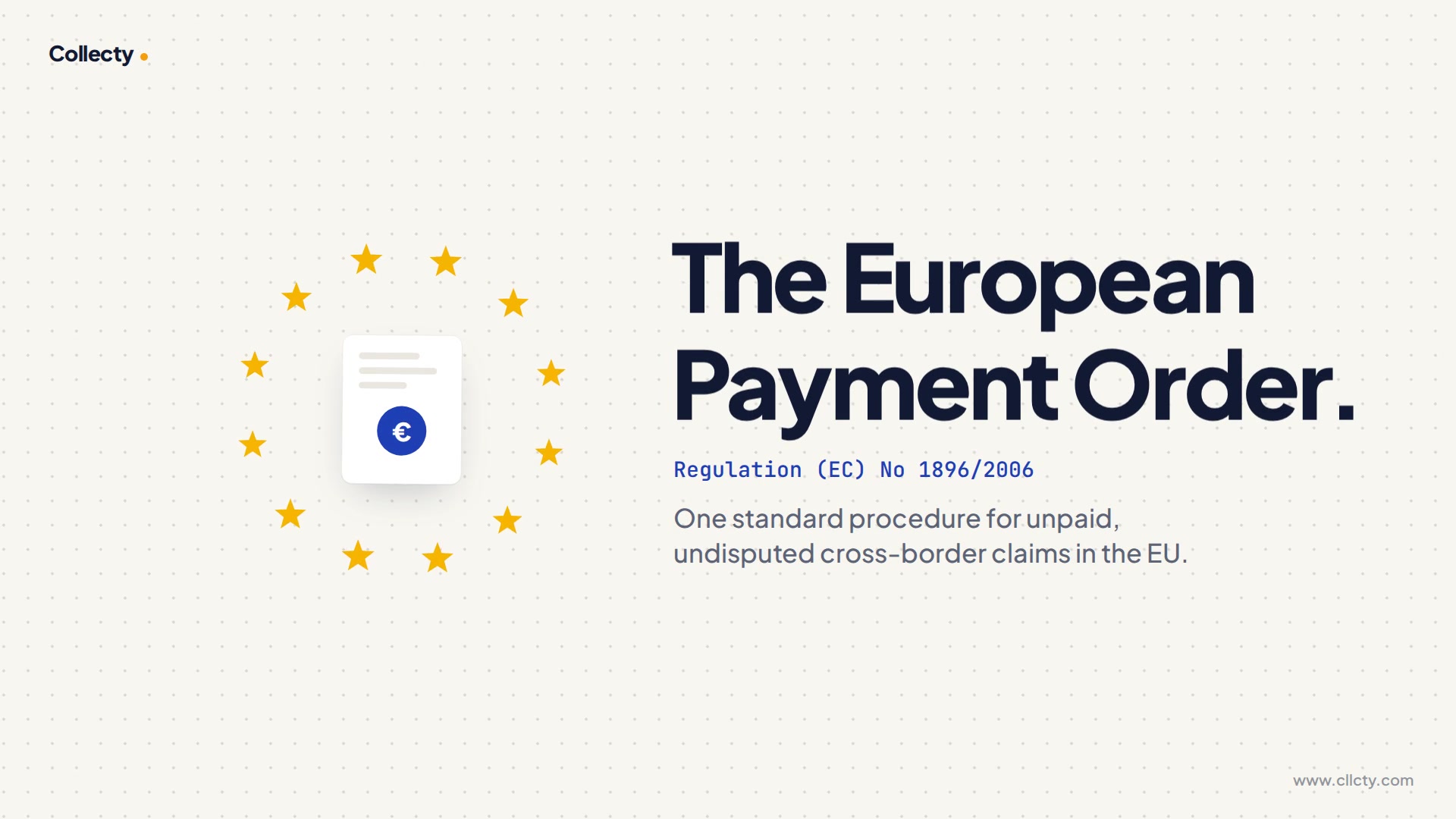
A step-by-step guide to the European order for payment procedure: who can use it, which court to file with, the 30-day objection window, and how to enforce the order in 26 EU countries.

You delivered the work. You shipped the goods. The invoice is 90 days overdue, and your client is in another country. They stopped responding. Here is what actually changes once the debt crosses a border — and what to do next.

New Anthropic data ranks debt conversations among the most AI-rehearsed tasks in the economy. What that means for every collection letter you send.

Six copy-paste scripts for reopening contact with a silent, defensive, or angry B2B debtor — built on the psychology of stress fallback. Free to use.

Your debtor isn't ignoring you. Their nervous system is. The psychology of fallback behavior in B2B collections — and the scripts that reopen the conversation.

Every article promises you the answer. We actually read the data — 718 occupations, ranked. What it really says about credit control jobs will surprise you.

Content creation is 22.7% of all AI usage — a planetary firehose. Why generic content drowns, and the four anti-flood assets that still win attention in 2026.

Cash flow forecasts die on the receivables line. In 2026 your customers' payment timing is partly algorithmic — here's the behavioural forecasting method that survives it.

Millions now confide in machines — many of them owners at 23:40. What the data shows, and the practical load-lightening that actually works.

Measured data from 121 countries reveals what humanity really asks AI. The finance findings — and the fact about compliance — should genuinely worry your AR.