By Collecty Research | Forensic Series: The Giant Client Trap
Reading time: 10 minutes
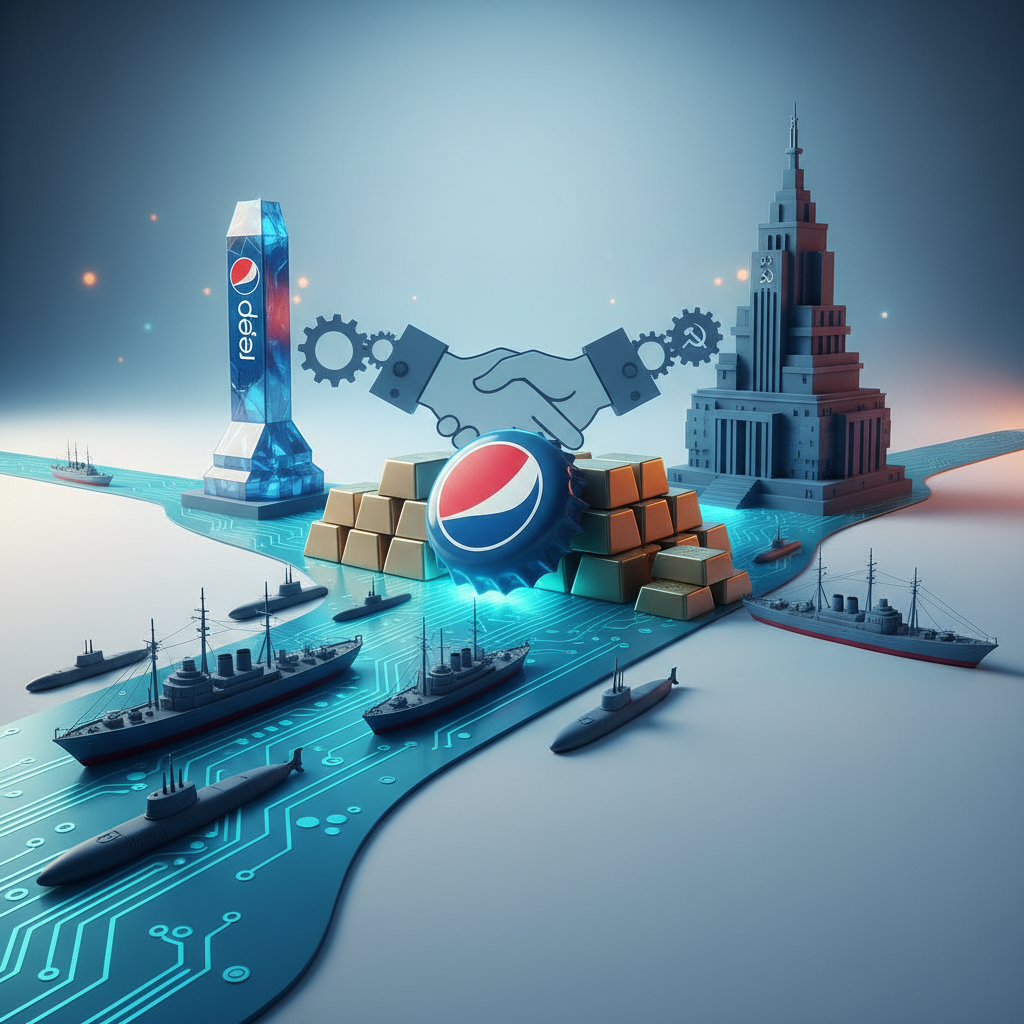
In 1989, PepsiCo agreed to a $3 billion deal with the Soviet Union:
Pepsi would provide concentrate for Pepsi-Cola.
The USSR would pay with 17 diesel submarines, 3 surface warships, 1 cruiser, and 1 oil tanker.
For a brief moment, Pepsi controlled more submarines than the United Kingdom, Canada, or Australia.
Pepsi became the 6th largest navy in the world.
Pepsi CEO Donald Kendall joked to U.S. National Security Advisor Brent Scowcroft:
"We're disarming the Soviet Union faster than you are."
This wasn't a publicity stunt. It was a serious barter deal — the only way to do business with a country whose currency wasn't accepted anywhere else.
Pepsi didn't want a navy. But submarines have scrap value. The deal worked because Pepsi could liquidate the ships immediately.
For B2B suppliers, the Pepsi-submarine deal is a case study in creative payment terms that actually work — and why most "creative payment offers" from your clients don't.
The Backstory: How Pepsi Got Into the USSR
1959: Khrushchev Tastes Pepsi
In July 1959, U.S. Vice President Richard Nixon hosted Soviet Premier Nikita Khrushchev at the American National Exhibition in Moscow.
At the Pepsi booth, Nixon handed Khrushchev a cup of Pepsi. Khrushchev tasted it. Liked it. Asked for more.
Pepsi's CEO at the time, Donald Kendall, was present. He saw an opportunity: get Pepsi into the Soviet market before Coca-Cola.
1972: The Vodka Deal
Pepsi negotiated a deal to sell Pepsi-Cola in the USSR. But there was a problem:
Soviet rubles were not convertible to dollars.
The USSR couldn't pay Pepsi in rubles because rubles had no value outside the Soviet Union. Pepsi couldn't take rubles back to the U.S. and exchange them for dollars.
Solution: Barter.
Pepsi would provide concentrate for Pepsi-Cola.
The USSR would pay in Stolichnaya vodka.
Pepsi would sell the vodka in the United States and convert it to dollars.
The deal worked. Pepsi became the first Western product sold in the USSR. Stolichnaya became a bestseller in the U.S.
1980s: USSR Wants More Pepsi
By the mid-1980s, Pepsi-Cola was hugely popular in the Soviet Union. The USSR wanted to expand production and distribution.
But vodka alone couldn't cover the volume. The USSR needed to offer something bigger.
1989: The Submarine Deal
The Soviet Union offered decommissioned warships as payment.
Specifically:
- 17 diesel submarines (Project 641 class, NATO designation "Foxtrot")
- 3 surface warships (frigates)
- 1 cruiser
- 1 oil tanker
Total value: $3 billion in Pepsi concentrate.
Pepsi agreed.
The Deal Mechanics
Why Did the USSR Offer Warships?
The Soviet Navy was in the process of decommissioning older diesel submarines and replacing them with modern nuclear-powered subs. The old ships had no military value but significant scrap value (steel, brass, copper).
Instead of scrapping the ships domestically, the USSR offered them as payment to Pepsi. Pepsi could scrap them abroad and convert the proceeds to dollars.
Why Did Pepsi Accept Warships?
Pepsi didn't want to run a navy. But submarines and warships are made of steel. Steel has market value.
Pepsi partnered with a Norwegian ship-breaking company (Aker Yards). The company would:
- Take possession of the Soviet ships
- Dismantle them for scrap metal
- Pay Pepsi the scrap value
Pepsi knew the scrap value upfront. The math worked. They accepted the deal.
How Did the Transfer Work?
The Soviet ships were delivered to Norway and Sweden for dismantling. Pepsi never actually "owned" a navy in any operational sense — the ships went straight to the scrapyards.
Pepsi received cash from the scrap proceeds, which covered the cost of the Pepsi concentrate delivered to the USSR.
The B2B Lesson: When Non-Cash Payment Works
Most "creative payment" offers from clients don't work. Equity, future contracts, barter deals — they sound innovative but usually leave you holding illiquid promises.
Pepsi's submarine deal worked because it passed four critical tests:
Test 1: Immediate Liquidation
Pepsi could convert submarines to cash immediately. The ship-breaking market was established. Buyers existed. Prices were known.
Compare this to common client offers:
- "Take equity instead of cash" → Illiquid. May never be worth anything.
- "We'll give you a bigger contract next year" → Not cash. Just a promise of future revenue.
- "Accept 50% now, rest when we get funding" → Still waiting on 50%.
None of these pass the liquidation test.
Rule: If you can't convert it to cash within 30 days, it's not payment — it's a promissory note.
Test 2: Known Market Value
Pepsi knew exactly what scrap steel was worth. They could calculate the value of the submarines before agreeing to the deal.
Compare this to:
- "Take our product as trade" → What's the resale value? Do you have buyers? Can you move it?
- "We'll barter services" → Are their services worth what you charge? Can you use them?
Rule: If you can't independently verify the market value, you can't price the deal.
Test 3: Immediate Possession
Pepsi took possession of the ships immediately. They didn't accept a "future delivery" promise.
Compare this to:
- "We'll transfer the equipment next quarter" → You're still waiting.
- "You'll get paid when we sell the assets" → You're a contingent creditor, not a secured one.
Rule: If you don't take possession NOW, you're still an unsecured creditor.
Test 4: Exit Strategy Ready
Pepsi had buyers lined up (the Norwegian ship-breakers) BEFORE closing the deal. They weren't stuck holding submarines hoping to find a buyer later.
Compare this to:
- "Take our inventory as payment" → Can you sell it? Do you have distribution channels?
- "We'll give you real estate" → Can you liquidate it quickly? Are there liens?
Rule: Don't accept assets unless you already know how to liquidate them.
When Barter Actually Works
Pepsi's submarine deal is famous, but it's not unique. Barter and non-cash payment CAN work in B2B if structured properly.
Successful Barter Examples
Vodka has a global market. Pepsi could sell it easily. Worked for 17 years.
Companies exporting to Iran often accept crude oil as payment. Oil has global commodity pricing and buyers.
During Zimbabwe's hyperinflation (2000s), B2B deals were settled in gold, fuel, or goods. Local currency was worthless.
Agricultural exporters accept coffee, cocoa, or grain as payment from countries with currency restrictions.
When Barter Fails
Most barter offers from clients fail because:
- No liquid market: "Take our proprietary software as payment" → Who's buying?
- Uncertain value: "We'll trade you marketing services" → How do you value that?
- Future delivery: "You'll get the assets when we finish the project" → Still waiting.
- No exit strategy: "Take our inventory" → You're not in that business. Now you're stuck.
What B2B Suppliers Should Demand
If your client can't pay cash, demand assets that pass the Pepsi Test:
Acceptable Non-Cash Payment
✅ Physical assets with scrap value: Equipment, machinery, vehicles (must be unencumbered — no liens)
✅ Tradeable commodities: Gold, silver, oil, grain (things with established market prices)
✅ Publicly traded securities: Stocks, bonds (must be liquid — not restricted shares)
✅ Real estate with clear title: Only if you have buyers ready or can liquidate via auction
Unacceptable "Creative Payment" Offers
❌ Equity in a private company: Illiquid. Unknown value. Requires you to wait for exit event (IPO, acquisition).
❌ Future contracts: Not an asset. Just a promise of future revenue.
❌ Barter of services: Subjective value. You may not need their services.
❌ Inventory from their business: Only acceptable if YOU can sell it easily (and if it's unencumbered).
❌ Cryptocurrency: Volatile. May be illiquid depending on the coin.
How to Structure a Non-Cash Payment Deal
Step 1: Verify Liquidation Market
Before accepting anything other than cash, answer:
- Is there a public market for this asset?
- Can I get 3 bids from buyers right now?
- What's the liquidation value (not the "book value" your client claims)?
Step 2: Discount Heavily
Pepsi didn't accept submarines at "face value." They valued them at scrap price — significantly less than replacement cost.
If your client offers a $100K piece of equipment, value it at liquidation price (maybe $40K). Demand the difference in cash or don't accept it.
Step 3: Take Possession Immediately
Don't accept "future delivery." If the asset isn't transferred to you NOW, you're still an unsecured creditor.
Step 4: Liquidate Immediately
Pepsi didn't hold submarines hoping they'd appreciate. They scrapped them ASAP and took cash.
Don't become an asset manager for your client's junk. Liquidate fast.
Step 5: Document Everything
Get:
- Written agreement specifying asset transfer
- Proof of ownership (title, deed, registration)
- Proof of no liens or encumbrances
- Valuation from an independent third party
If your client can't provide these, they don't actually own the asset (or it's encumbered).
What If Your Client Can't Offer Real Assets?
If your client:
- Can't pay cash
- Can't offer liquidatable assets
- Can only offer "promises" (equity, future contracts, barter of services)
Then they can't pay you.
Stop shipping. Escalate to collections. Don't accept illiquid promises dressed up as "creative solutions."
Pepsi accepted submarines because submarines have scrap value.
Your client's "equity offer" has no value until there's a liquidity event (which may never come).
The Bigger Picture: Currency Risk and Barter
Pepsi's submarine deal happened because the Soviet ruble was worthless internationally. Barter was the only option.
Today, similar situations exist:
- Venezuela: Hyperinflation makes bolivars worthless. Oil companies barter for crude.
- Iran: Sanctions restrict currency exchange. Barter common.
- Argentina: Currency controls and inflation make peso deals risky. Barter or dollar-denominated deals preferred.
- Zimbabwe (historically): Hyperinflation made local currency useless. Gold and goods became currency.
If you're exporting to countries with currency restrictions, sanctions, or hyperinflation, barter may be necessary.
But apply the Pepsi Test: immediate liquidation, known value, take possession now, exit strategy ready.
The Punchline
Pepsi accepted 17 submarines and became the world's 6th largest navy.
It worked because:
- Submarines have scrap value
- Scrap value is known
- Buyers exist (ship-breakers)
- Pepsi took possession immediately
- Pepsi liquidated immediately
Your client's offer to "pay in equity" or "make it up next year" passes ZERO of these tests.
If your client can't pay in cash, demand assets with liquidation value.
Otherwise, you're not Pepsi. You're just a creditor with a creative excuse.
Client offering non-cash payment? Collecty specializes in B2B debt recovery and asset valuation. 80%+ success rate. 160+ countries. No win, no fee. Free case assessment →
Sources
- The Guardian: "When Pepsi became the sixth largest military in the world" (2019)
- Business Insider: "How Pepsi Briefly Became the 6th Largest Military in the World" (2018)
- New York Times: "Pepsi Will Be Bartered for Ships; Accord With Soviets Is First of Its Kind" (1990)
- Forbes: "The Story of When Pepsi Traded Soft Drinks for Soviet Warships" (2020)
- National Archives: Nixon-Khrushchev Kitchen Debate records (1959)
- PepsiCo Corporate History: Soviet Union market entry documentation
- Cold War International History Project: U.S.-Soviet trade agreements (1970s-1990s)

Sarah Lindberg
International Operations Lead
Sarah coordinates our global partner network across 160+ countries, ensuring seamless cross-border debt recovery.