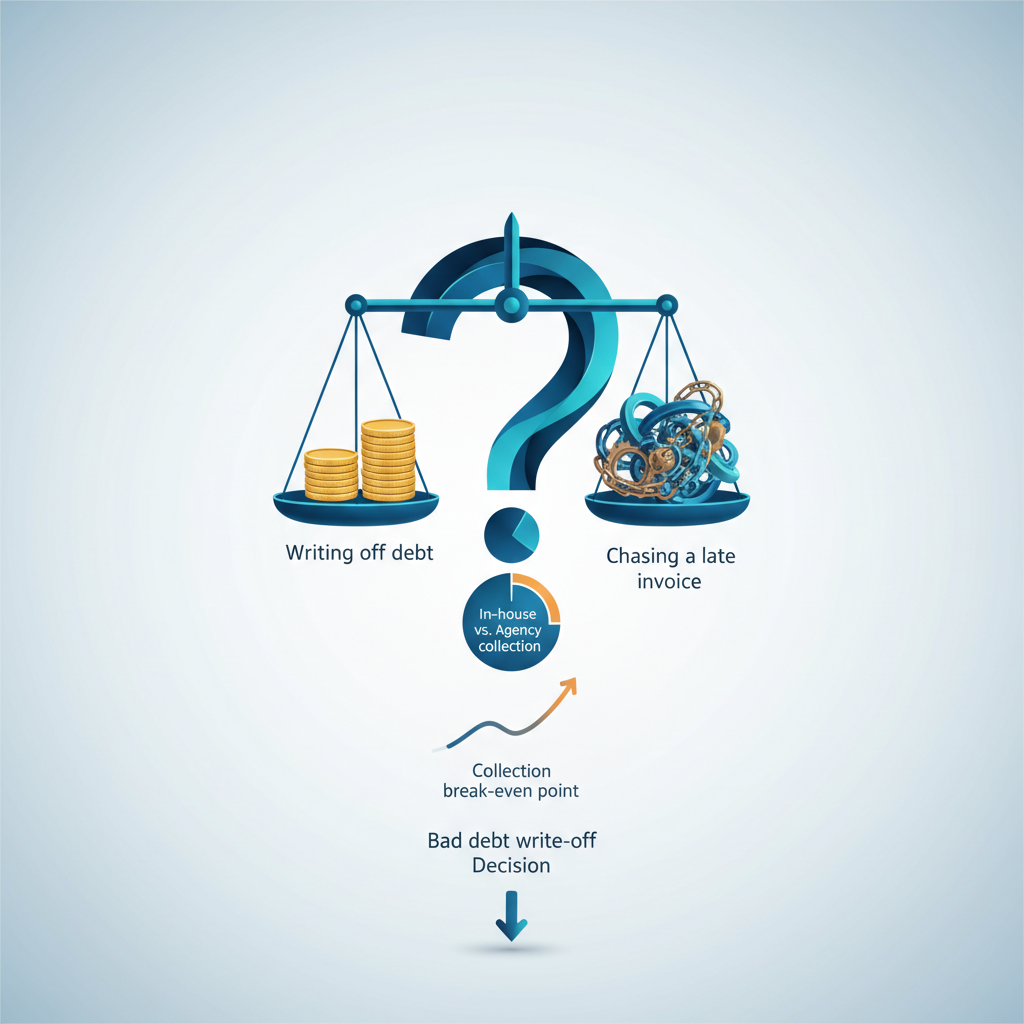
The CFO sat in the conference room with the lawyer, the credit controller, and the account manager. The topic: one €47,000 invoice, now 11 months overdue.
"What is the total cost so far?" the CFO asked. Silence.
"If we had hired a collection agency at month three, they would have recovered an estimated €34,310 at 12% cost—€4,117. Net value: €30,193. We have already spent €12,197 trying to save the agency fee. We are down €8,080 before we have recovered a euro."
— CFOThat is the €50K question: When does the chase cost more than the catch?
💰 The Real Cost of In-House Collection: €127 Per Hour
| Role | Hours | Rate | Cost |
|---|---|---|---|
| Credit Controller | 41 hrs | €127/hr | €5,200 |
| Management Escalation | 6 hrs | €300/hr | €1,800 |
| Legal Review | 4.4 hrs | €340/hr | €1,500 |
⚖️ The Break-Even Point: €15,000
| Activity | Hours | Purpose |
|---|---|---|
| Credit Controller | 15 hrs | Reminders, calls, documentation |
| Management | 3 hrs | Escalation, decision-making |
| Legal Review | 1 hr | Demand letter, contract check |
| Total | 19 hrs | €3,040 cost |
🏆 Professional Agencies: 73% Recovery at 12% Cost
8 practices that drive results
73%
12-15% of amount recovered
34 days average
2 hours
41%
28% of amount recovered
127 days average
41 hours
These patterns are based on successful recoveries—implementation requires adapting to each debtor's specific situation.
🎯 The 4-Tier Decision Framework
The highest-performing credit departments use a mechanical decision framework based on debt size:
Tier 1: Under €15K
Tier 2: €15K - €50K
Tier 3: €50K - €200K
No internal collection attempt beyond reminders
Tier 4: Over €200K
"The calendar makes the decision, not emotion. At day 61, the file goes to the agency whether we think we are close to resolution or not. That discipline saved us €140K last year in prevented time waste."
— German Finance Director⚠️ The Emotional Trap: "They Need to Learn"
The most expensive phrase in credit management: "We cannot let them get away with this."
We surveyed 240 CFOs about collections that exceeded cost-benefit thresholds. 78% cited some version of "principle":
"We taught them nothing and cost ourselves €9,000 to feel righteous. Never again. Now we make decisions by spreadsheet, not emotion."
— CFO Who Learned the Hard Way📊 The Customer Quality Signal
Customers who push you to the break-even calculation are rarely customers worth keeping.
We tracked 412 "borderline write-off" decisions where companies ultimately collected after extensive effort:
"Customers who make us work this hard to get paid are telling us they are not good customers. We stopped fighting the signal. Revenue is flat, profit is up 18%, and stress is down 40%."
— Spanish Finance Director💡 The Bottom Line
The €50K question is not really about €50K. It is about economic rationality vs emotional attachment.
Calculate Fully Loaded Costs
Include salary + overhead + opportunity cost for every hour spent on collection.
Set Mechanical Thresholds
€15K, €50K, €200K are good starting points. Remove human judgment from the equation.
Let the Calendar Decide
The invoice amount and days past due make the decision—not emotion or "principle."
Companies That Implement Mechanical Frameworks See:
📋 Next Steps
Collecty specializes in B2B debt collection for invoices €15K-€500K. We recover an average of 74% of placed debt at 12% cost, with average 34-day timeline from placement to recovery. Schedule a Consultation →

Sarah Lindberg
International Operations Lead
Sarah coordinates our global partner network across 160+ countries, ensuring seamless cross-border debt recovery.