A Number That Should Keep Every Creditor Awake
"The United States is entering a fiscal environment without a historical parallel: $35 trillion in debt with no post-war industrial boom to bridge the gap."
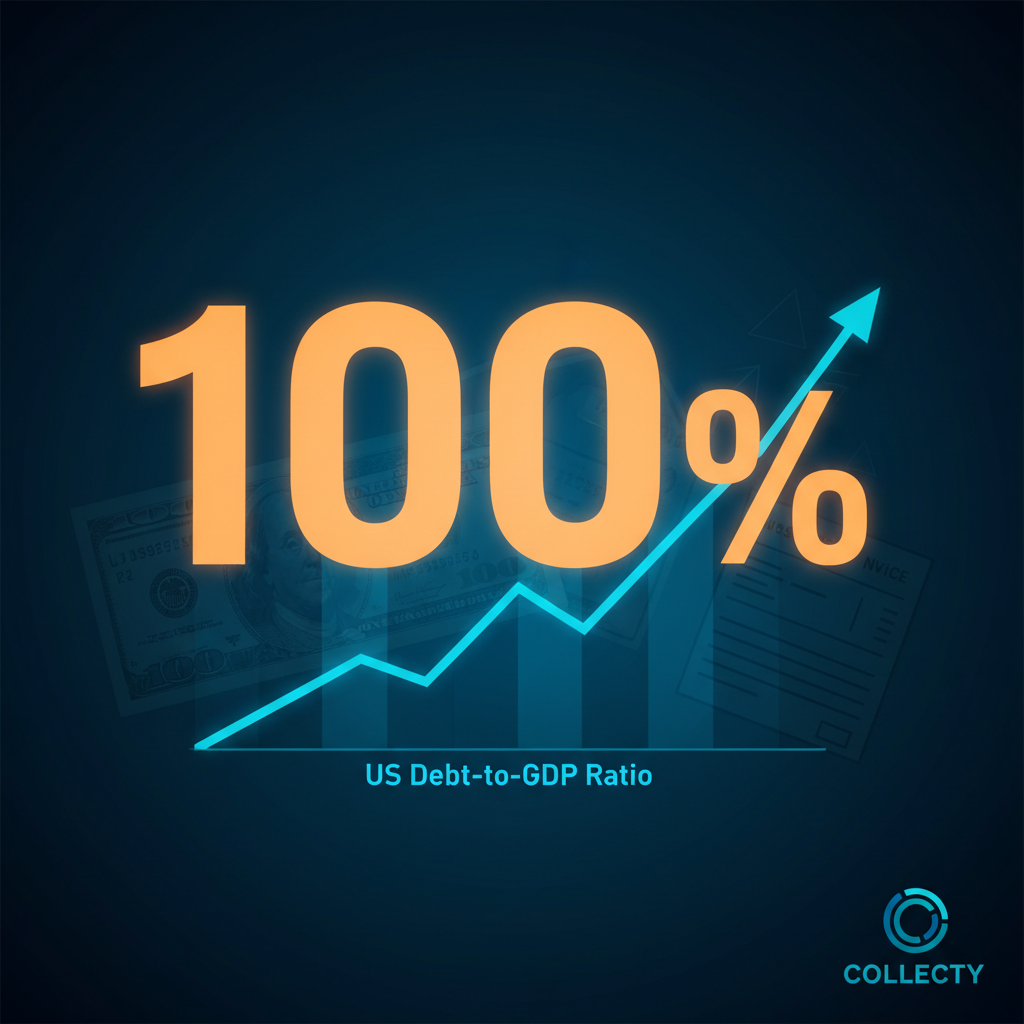
The crossing of the 100 percent debt-to-GDP threshold represents more than a psychological milestone; it is a structural pivot point for global finance. For the first time since the aftermath of World War II, the American economy is carrying a debt load that equals its total annual output. However, unlike the 1940s, the current trajectory lacks the tailwinds of a global rebuilding effort or a demographic explosion. Instead, we face a $1 trillion annual interest bill—a figure that now exceeds the national defense budget.
For B2B creditors and CFOs, this macro-volatility translates directly into micro-level risk. As the federal government absorbs available liquidity to service its obligations, the cost of capital for private enterprise drifts upward. This is the mechanism that transforms "sovereign debt" into "delinquent invoices." When capital is diverted to service the national debt, the velocity of money slowed, and the reliability of your aging report begins to degrade.
The Mechanics of a Sovereign Debt Squeeze
"When the government competes for capital at a trillion-dollar scale, the private sector is inevitably pushed to the back of the lending queue."
The immediate consequence of federal deficit spending is the "crowding out" of private credit. As the Treasury issues $9.2 trillion in new securities to roll over existing debt, it consumes the same pool of institutional capital that banks use to fund commercial lines of credit. This competition ensures that interest rates remain "higher for longer," regardless of inflationary trends, as the government must keep yields attractive to maintain demand for its debt.
The ripple effect hits middle-market companies the hardest. As bank lending standards tighten in response to systemic liquidity pressure, businesses find their working capital evaporated. This manifests in the B2B sector as a tactical extension of payables. Your customers are not necessarily failing; they are being forced to use their suppliers as a source of interest-free financing because their traditional credit lines have been capped or priced out of reach.
The CRFB Warning
"We are operating without a fiscal cushion; the next economic shock will find the Treasury with its hands tied and its cupboards bare."
The Committee for a Responsible Federal Budget (CRFB) has issued a stark assessment: the United States is "woefully underprepared" for an economic downturn. Historically, the federal government could spend its way out of a recession through stimulus and credit guarantees. With debt at 100% of GDP, that playbook is effectively closed. There is no capacity for a massive backstop if the corporate bond market seizes or the commercial real estate sector collapses.
For finance leaders, this means the "safety net" is gone. In previous cycles, government intervention often provided the liquidity that allowed struggling debtors to eventually catch up on their payables. In the 2026-2027 cycle, creditors should expect no such rescue. Credit risk must now be managed under the assumption that if a debtor falls, there is no federal liquidity injection coming to pick them back up.
What Is Actually Happening to Business Payments
"The transition from 60-day to 120-day payment cycles is the first sign of a structural breakdown in trade credit."
Current market data suggests a fundamental shift in corporate treasury behavior. We are observing several critical trends that threaten balance sheet stability:
- The Inversion of Aging: Standard 30-day terms are being ignored in favor of 90 and 120-day cycles as companies prioritize "runway" over vendor relationships.
- The Refinancing Trap: Mid-market firms that survived on 3% debt are now hitting a refinancing wall at 7% or 8%. The resulting spike in interest expense is being carved directly out of the budget previously reserved for supplier invoices.
- Credit Insurance Retrenchment: Insurers are pulling back from high-exposure sectors, making it more difficult to hedge against localized failures.
This is not a temporary delay; it is the new baseline for B2B commerce in a debt-saturated economy. Every day an invoice remains unpaid, the risk of total loss increases exponentially as the debtor's available cash is diverted to service their senior bank debt.
Sectors Under Maximum Pressure
"Distress is no longer isolated; it is cascading through the supply chains of our most foundational industries."
Identifying high-risk categories is essential for proactive credit management as the squeeze intensifies:
- Commercial Real Estate & Construction: Faced with a "refinancing cliff," many operators are prioritizing mortgage payments over contractor and supplier fees.
- Retail & Consumer Goods: As discretionary income is eaten by higher household debt costs, retailers are stretching their whole supply chain to maintain inventory levels.
- Healthcare Services: Dependent on government reimbursement and facing labor inflation, this sector is seeing massive delays in accounts payable.
- Technology & SaaS: The era of "growth at any cost" is over. These firms are now aggressively managing cash burn, often at the expense of their vendors.
The Collection Imperative
"In a liquidity crisis, the squeaky wheel doesn't just get the grease—it gets the only remaining cash in the bank."
Passive credit management is a recipe for catastrophic write-offs in the current environment. When a debtor has limited funds, they perform a triage of their liabilities. Payroll is first, taxes are second, and the most persistent, professional creditor is third. Those who wait for "polite reminders" to work will find themselves at the bottom of the pile, often after the cash has already run out.
Speed is the primary determinant of recovery. Professional intervention signals to the debtor that your invoice is a "hard" obligation that cannot be deferred. By establishing urgency and consequences early in the delinquency cycle, you move your claim ahead of the pack. Especially in cross-border trade, where US fiscal policy creates currency volatility, immediate action is the only way to protect the original value of the contract.
Protect Your Receivables Before the Wave Hits
"Strategic recovery is the only effective hedge against a systemic credit contraction."
The 2026 refinancing wave is no longer a distant threat; its shadow is already cooling the credit markets. As sovereign debt continues to crowd out private capital, the businesses that survive will be those that treat their accounts receivable with the same urgency as their cash at hand.
COLLECTY provides the global infrastructure needed to navigate this volatility. With 25 years of experience across 100+ jurisdictions, we understand the nuances of recovering debt when liquidity vanishes. We don't just ask for payment; we navigate the complexities of modern credit traps to ensure your balance sheet remains resilient.
Visit cllcty.com → to secure your receivables before the next shockwave reaches your industry.

Sarah Lindberg
International Operations Lead
Sarah coordinates our global partner network across 160+ countries, ensuring seamless cross-border debt recovery.