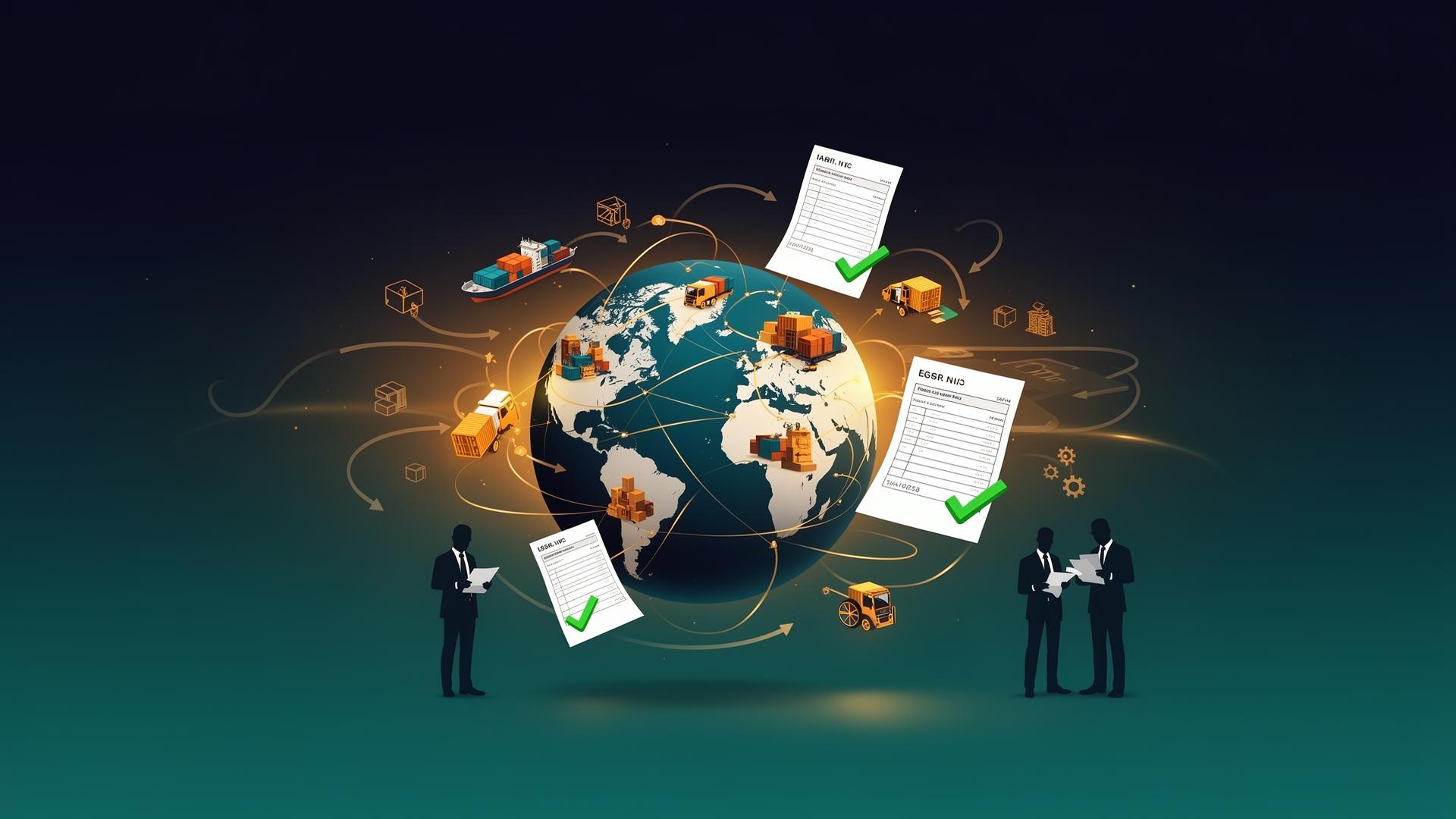
When your debtor is in another country and an invoice goes unpaid, the question isn't whether enforcement is possible—it's whether your case will survive the handoff. Too many cross-border receivables collections stall at the awkward intersection of "we need a local lawyer" and "let's try amicable first." The result? Months of delay while your invoice collects dust instead of payment.
This guide provides a structured cross-border enforcement playbook—the Jurisdiction Handoff Ladder™—that prevents handoff delays and clarifies when to escalate. Your invoice shouldn't need a passport stamp for every follow-up. It needs a process. For related strategies on collecting from international clients, see our guide on how to collect a debt from international clients.
What "enforcement" means in cross-border B2B (in plain language)
Before diving into the ladder, let's clarify what cross-border debt collection enforcement actually means. It's not a single action—it's a spectrum of escalating pressure:
- Amicable collection: Professional outreach, payment reminders, negotiation
- Pre-legal pressure: Formal demand letters, escalation notices, deadline enforcement
- Legal action: Filing claims, court proceedings, arbitration (varies by jurisdiction)
- Judgment: Obtaining a legal decision in your favor
- Asset reach: Actually collecting—through garnishment, liens, or enforcement mechanisms
Each stage has different requirements, timelines, and costs depending on where your debtor is located. Country rules vary significantly—always consult local counsel for jurisdiction-specific advice. This guide covers the high-level process and decision framework, not legal instructions.
Why cross-border cases fail (the handoff problem)
Most international debt collectors for businesses will tell you they have a "global network." What they often don't mention is how cases get lost in that network. Here are the 8 most common failure points in multi-jurisdiction debt collection:
What Goes Wrong
Your Firm
Case submitted
"Partner"
Reassigned
Unknown
Lost in the shuffle
Warning Signs of Partner Handoffs
Any of these? Ask harder questions.
- Missing evidence pack: Case starts without complete documentation
- Wrong contracting entity: You're chasing a subsidiary when the contract is with the parent
- No acceptance proof: Debtor claims goods weren't delivered or services weren't completed
- Dispute raised late: Debtor invents a dispute at the last moment to stall
- Language/culture mismatch: Communications fail because of tone or timing expectations
- No escalation triggers: Case sits in "amicable" phase indefinitely with no decision gates
- "Partner handoff" with no owner: File gets passed to a local contact who doesn't know the case history
- Debtor has assets in a different country: Judgment in Country A is meaningless if assets are in Country B
The phrase "we'll find someone local" is not a handoff protocol. It's a warning sign.
The enemy: Jurisdiction handoff delays
Here's what typically happens when your case requires cross-border routing: it gets bounced. First to "our team in Country A," then to "a partner in Country B," then to silence. Each handoff loses context, urgency, and ownership. The cross-border collections process should prevent this—not enable it.
What Goes Wrong
Your Firm
Case submitted
"Partner"
Reassigned
Unknown
Lost in the shuffle
Warning Signs of Partner Handoffs
Any of these? Ask harder questions.
- No single case manager across jurisdictions
- "We'll find a local partner" with no timeline or named contact
- File passed without documentation standards
- No reporting during handoff periods
- Unclear which country's rules apply to your case
- Assets identified but no routing plan created
If your case has more country stamps than a diplomat's passport—but no progress—that's a sign.
The Jurisdiction Handoff Ladder™ (the method that prevents stall-outs)
Goal: Complete file before any routing decisions
- Inputs: Contract/PO/SOW, invoices, statement of account, delivery/acceptance proof, communications log, debtor details
- Output: "Cross-Border Evidence Pack v1"
- Escalation trigger: If critical documents missing → issue request list with 48-hour deadline
Cross-border enforcement evidence pack (what matters most)
| Item | Why it matters | Common problem |
|---|---|---|
| Contract/PO/SOW + governing law clause | Determines jurisdiction options and applicable law | Clause missing, contradictory, or buried in T&Cs |
| Delivery/acceptance proof | Shows you fulfilled your obligation | Verbal-only confirmations, no signed POD |
| Invoice + payment terms | Establishes claim amount and due date | Terms scattered across multiple documents |
| SOA (statement of account) | Shows running balance and payment history | Out of date or doesn't match invoices |
| Debtor legal entity details | Must match contracting party exactly | Parent/subsidiary confusion, wrong entity name |
| Communications log + payment promises | Evidence of debtor awareness and intent | Not timestamped, missing key conversations |
| Dispute notes (if any) | Separates disputed from undisputed portion | Dispute raised late without specifics |
| Asset hints (banks, customers, subsidiaries) | Enables enforcement routing if needed | Unknown, guessed, or outdated information |
Email templates (cross-border friendly, compliant)
Subject: Invoice [NUMBER] – Confirmation of Balance and Payment Date

Dear [NAME],
Routing decision box: Where is the debtor vs where are the assets?
Before escalating, map the geography. Assets don't file change-of-address cards—you need to know where they are.
True Dispute
Handle through normal channels
- Debtor and assets appear to be in the same country
- Contract has clear governing law clause matching debtor location
- No subsidiaries or parent entities in other jurisdictions
- Debtor has local bank accounts and customer relationships
Workflow Stall
Escalate immediately
- Assets likely in different country than debtor's registered office
- Contract governing law differs from debtor's jurisdiction
- Parent company in one country, operating subsidiary in another
- Payment was routed through a third country
Action
Map assets before choosing escalation path. If dispute is genuine → resolve dispute first. If debtor is stalling → escalate with complete file.
Choose the right country workflow
Pick the next best step
FAQ
Conclusion
Enforcing B2B debt across jurisdictions isn't impossible—it's just poorly organized at most firms. The Jurisdiction Handoff Ladder™ ensures your case has standardized documentation, clear jurisdiction mapping, decision gates that prevent indefinite stalling, and reporting discipline that maintains momentum.
If you have a debtor in another country with an unpaid invoice, the question isn't whether to pursue it. The question is whether you have the right process to prevent handoff delays and actually reach resolution.
Request a collections assessment to discuss your specific case. No guarantees—just a structured approach to cross-border enforcement that actually moves forward.

Elena Vasquez
Legal Affairs Director
Elena leads our legal escalation team with expertise in multi-jurisdictional enforcement and commercial litigation strategy.