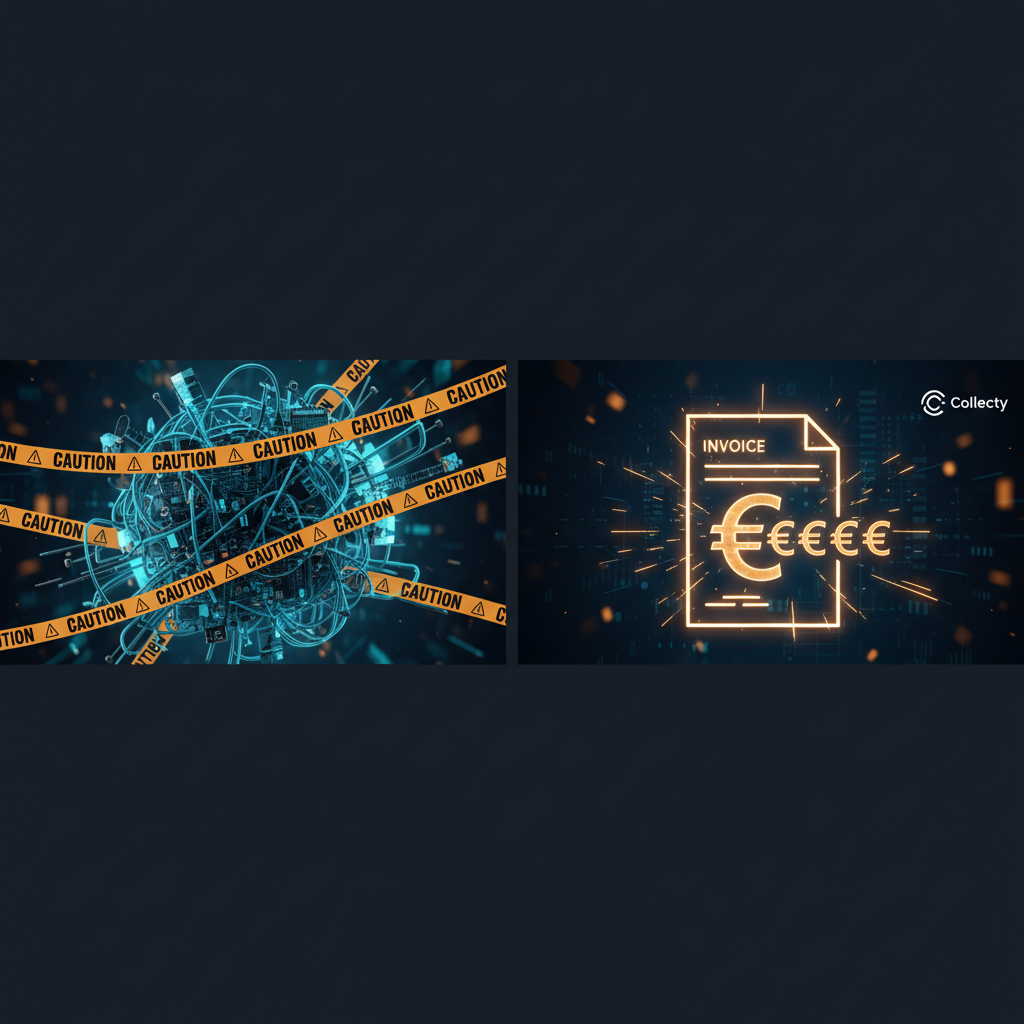
The Invoice That Looked Fine Until It Wasn't
"A customer who paid in 38 days is now paying in 54—this is the quiet tremor before a credit event."
There is a particular kind of quiet in accounts receivable departments right now. It is the quiet of finance professionals staring at aging reports and noticing that the numbers have shifted—not dramatically, but enough to signal underlying instability. A customer who historically paid in 38 days is now reaching 54. Another has requested extended terms for the first time in an four-year relationship. A third has ghosted communication entirely. Individually, these are hiccups; together, they represent a systemic shift identified by commercial debt recovery experts as tariff-driven credit risk.
In 2026, the catalyst for this friction isn't internal mismanagement, but global trade policy. These "early tremors" often originate 4,000 miles away from your headquarters, caused by margin compression that forces even your most reliable customers to prioritize capital preservation over vendor loyalty. When the quiet finally breaks, it usually takes the form of a default that traditional credit monitoring failed to predict. Understanding these subtle shifts is now the price of entry for modern credit management.
How a 30% Tariff Becomes Your Problem
"Tariff-driven credit risk is invisible because it examines your customer’s financials, but not their customer’s exposure."
The July 2025 announcement of 30% tariffs on EU goods sent shockwaves through the B2B supply chain, though the impact on accounts receivable was not immediately apparent. When margins compress by a third overnight, the corporate response is rarely to stop production; instead, firms choose to "borrow" liquidity from their suppliers. A manufacturer in Stuttgart may absorb a tariff increase to maintain an American contract, but they compensate for this loss by delaying payments to their own Italian component firms or French logistics providers.
This contagion move creates a domino effect:
- Margin Evaporation: Profit buffers intended for growth are redirected to cover government duties.
- Liquidity Stretching: Cash flow becomes stagnant as every player in the chain attempts to hold onto capital longer.
- Invisible Exposure: Routine credit checks often miss the fact that your customer's primary revenue stream is now 30% more expensive for their end buyer.
The Numbers Behind the Quiet Crisis
"Global business insolvencies are forecast to reach 24% above pre-pandemic levels—a permanent new baseline."
The data from Allianz Trade paints a sobering picture of the 2026 landscape. We are witnessing five consecutive years of insolvency growth, with global figures set to rise by 11% over the next 24 months. This isn't a temporary market correction; it is a fundamental shift in the risk environment. In Europe, the situation is even more acute: France is tracking toward a record 67,500 insolvency cases, while Italy has seen a staggering 45% increase in business failures.
Trade war scenarios add an additional 4.8 percentage points to these risks, pushing payment times past the 61-day average. For CFOs, this means the DSO benchmarks used just eighteen months ago are now dangerously obsolete, necessitating a complete overhaul of credit expectations.
Why Your Credit Model Is Probably Wrong
"One default in a tariff-exposed chain can cascade through dozens of B2B relationships simultaneously."
Most legacy credit models are built on historical payment data and static ratios like Debt-to-Equity. However, these models are ill-equipped for a world of rapid trade disruption. They fail to account for "supply chain tariff exposure"—the specific degree to which a customer’s cash flow is vulnerable to geopolitical shifts. A German automotive firm might look healthy on paper, but if 40% of their revenue is tied to exports that just became 30% more expensive, their solvency is a ticking clock.
This risk is particularly concentrated in sectors such as:
- Automotive & Aerospace: High-value components with complex international assembly.
- Industrial Machinery: Long-lead products where cost increases cannot be easily passed on.
- Logistics & Freight: The intersection point of every disrupted supply chain.
The 60-Day Rule
"Waiting 120 days for payment is no longer 'patient'—it is active wealth destruction."
In the current environment, time is your greatest enemy. Data from international debt collection indicates that for every day an invoice remains unpaid past the 60-day mark, the probability of full recovery drops by approximately 1%. By the time an invoice reaches 120 days, you have lost nearly 50% of your leverage. In a tariff-disrupted market, waiting is a high-cost gamble. Leading finance teams are responding by mapping portfolios against tariff-exposed geographies and reassessing credit limits quarterly. Most importantly, they are escalating collection activity at the 60-day threshold. Early intervention is no longer about aggression; it is about preserving the working capital necessary to survive structural market shifts.
What Nobody Wants to Admit
"A 30% cost increase from tariffs does not disappear with the business cycle; it is a permanent margin squeeze."
The uncomfortable reality for many CFOs is that tariff-driven credit risk is structural, not cyclical. Unlike a typical economic downturn where markets eventually rebound and payment patterns normalize, tariffs represent a permanent increase in the cost of doing business. These costs do not self-correct; they permanently alter the competitive landscape and squeeze margins across the entire chain. Treating these delays as "temporary" is a strategic error that converts valuable assets into eventual write-offs.
As 1.2 million jobs across Europe come under threat due to trade tensions, payment hierarchies are becoming rigid. Every struggling firm is making a daily decision on which vendors to pay and which to stall. If your credit department remains passive, your invoices will inevitably migrate to the bottom of the priority list. Recognizing that this is a structural shift allows you to move away from reactive waiting and toward proactive capital recovery and risk mitigation before the liquidity window closes.
The Collecty Perspective
"The firms that act early recover more, spend less, and preserve the relationships that matter."
At Collecty, we operate at the heart of the payment chains being rearranged by global trade policy. We see firsthand which sectors are stretching their terms and which corridors are beginning to fracture. Our data shows a clear divergence: companies that intervene early—specifically those that recognize the structural nature of today's credit risk—maintain healthier cash flows and stronger commercial ties. If your receivables portfolio has exposure to tariff-affected trade corridors, the cost of inaction is rising daily. We provide the expertise and the infrastructure to ensure your invoices remain at the top of the payment list.

Sarah Lindberg
International Operations Lead
Sarah coordinates our global partner network across 160+ countries, ensuring seamless cross-border debt recovery.