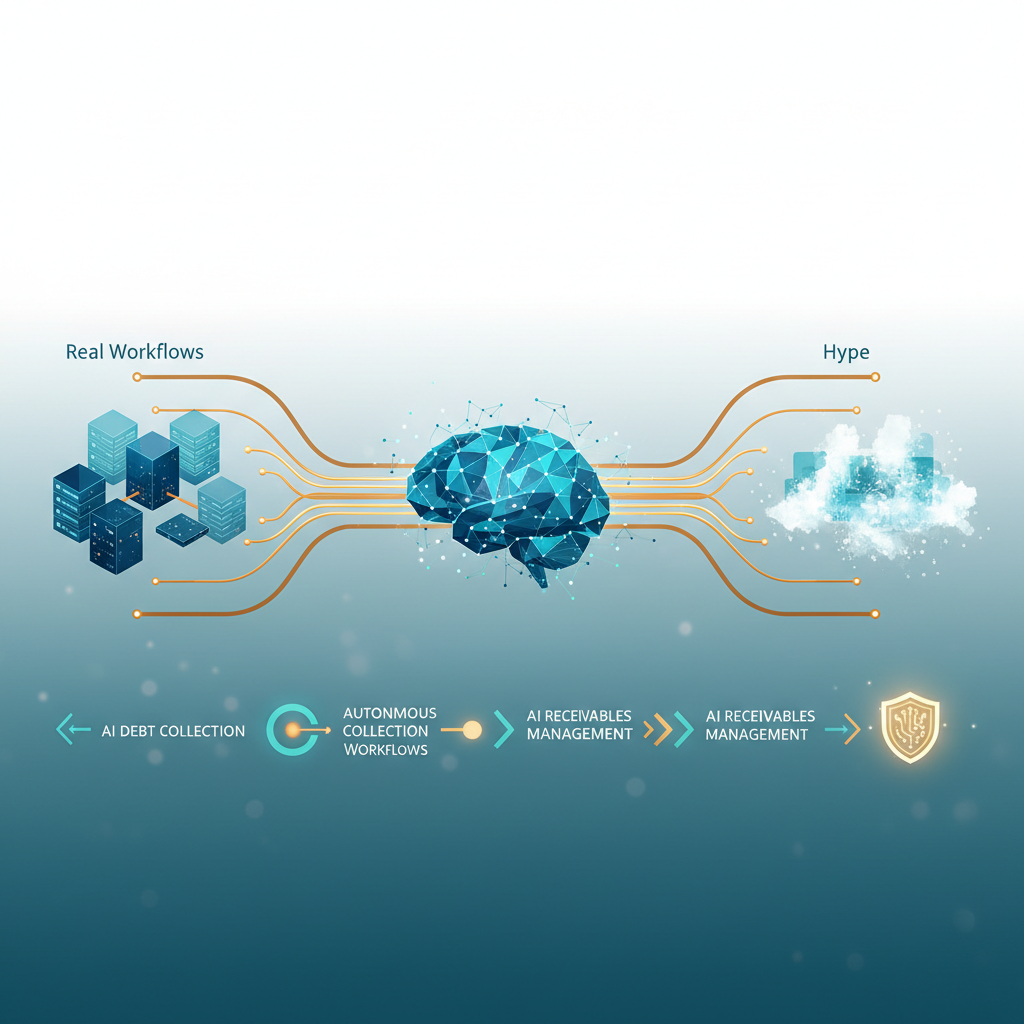
The Machines Have Entered the Collections Floor
"AI in debt recovery is not about sentient robots; it is about algorithms reading the room better than a human collector on a Friday afternoon."
A quiet revolution has fundamentally reshaped the collections landscape. Somewhere between the persistence of unanswered emails and the futility of ghosted voicemails, Artificial Intelligence moved into debt recovery. This isn't science fiction; it is a clinical, data-driven evolution where machines execute the nuances of negotiation—timing, tone, and channel—at a scale previously unimaginable. The global AI debt collection market, valued at $3.34 billion in 2024, is on a trajectory to hit nearly $16 billion by 2034.
With over 70% of agencies now integrating AI-powered tools, the technology has officially clocked in. For finance leaders, this represents a transition from labor-intensive manual outreach to high-velocity, automated recovery. The results are stark: AI is currently outperforming traditional human-led benchmarks on pure volume and consistency. Below, we examine the six pivotal categories of AI transformation currently redefining the industry from the ground up.
1. Compliance and Quality Monitoring AI
"The machine reviews every single conversation, ensuring the compliance team stops drowning in recordings and starts managing risk."
Before AI learned to collect, it learned to listen. Modern platforms like Sedric AI have replaced the archaic "sampling" method—where perhaps 2% of calls were reviewed—with 100% automated auditing across dozens of languages. These systems flag Reg F and UDAAP violations in real-time, providing an immediate safety net during live interactions.
- Real-Time Mitigation: Identifying missed disclosures while the collector is still on the line.
- Global Versatility: Handling international collections by adapting to shifting regulatory frameworks across jurisdictions.
- Operational Focus: Surfacing only the high-risk conversations that truly require human intervention.
For the modern CFO, this technology serves as essential insurance. A single regulatory failure can terminate a client relationship; AI ensures that every interaction stays strictly within the lines.
2. AI Chatbots and Digital-First Communication
"Given the choice between a phone call and a text-based interface at 11pm, modern debtors choose the screen every time."
The modern debtor is characterized by a profound desire for digital autonomy. Recognizing that phone calls are often viewed as intrusive, leaders like TrueAccord have pioneered machine-learning engines that determine the optimal channel and timing for outreach. By analyzing engagement signals—such as click-through rates and open times—the system crafts a bespoke communication journey for every individual. This move away from rigid call scripts has yielded up to a 10x increase in response rates compared to traditional methods.
Gartner forecasts that AI chatbots will manage 75% of initial customer interactions by 2025. This is particularly vital in commercial debt recovery, where stakeholders are often unreachable during standard business hours. A digital nudge delivered at 7:00 AM can bypass the gatekeepers of the traditional office environment, securing engagement before the workday even begins.
3. Predictive Scoring and Account Prioritisation
"Algorithmic calling decisions achieve 23.4% higher repayment rates by stopping collectors from chasing accounts that won't pay."
Collection efficiency is a game of finite hours. Predictive AI removes the guesswork by processing payment histories and behavioral signals to calculate a precise repayment probability for every account. This allows agencies to segment portfolios into high, moderate, and low-likelihood tiers, optimizing resource allocation instantly.
- Yield Optimization: Significant increase in repayment rates through data-led prioritization.
- ROI Acceleration: Financial institutions report a 77% return on AI deployments for risk scoring.
- Strategic Focus: Ensuring receivables management efforts are concentrated where liquid recovery is most probable.
This isn't just a tech story; it's a productivity story. By directing human talent away from "dead" accounts, agencies maximize their recovery per hour worked.
4. Voice AI and Agent Support Tools
"Voice AI drops the cost per interaction from over $25 to under $2, fundamentally altering the economics of recovery."
Voice AI technology currently operates in two distinct but complementary spheres. First, autonomous voice agents like Skit.ai manage outbound calls and basic negotiations, achieving containment rates of nearly 50%. This handles the heavy lifting of low-balance, high-volume accounts without human involvement. Second, agent-assist tools like Prodigal's proAssist provide collectors with real-time prompts and data summaries during complex calls.
The economic impact is undeniable. Human-handled claims can cost upwards of $118, while AI-managed interactions cost less than $2. This allows firms to reserve their most empathetic and skilled human negotiators for high-stakes commercial disputes, while the machines maintain the velocity of the broader portfolio. The choice is no longer ideological; it is a matter of strict fiscal discipline.
5. Autonomous Negotiation and Settlement AI
"The software evaluates financial health and closes agreements in real-time—handling thousands of negotiations simultaneously."
Artificial Intelligence has moved beyond simple reminders into the realm of complex settlements. Modern systems can analyze a debtor's financial health on the fly, proposing and closing installment plans within a single digital session. These autonomous systems evaluate the probability that a payment promise will be kept and can accept or reject counters-offers based on predefined risk parameters.
- Throughput: Scaling negotiations to thousands of simultaneous interactions.
- Litigation Reduction: Resolving legal debt recovery scenarios through settlement before escalation.
- Cost Reduction: Driving down collection costs by up to 40% through automation.
The next frontier arrives in 2026: debtor-side AI agents. Soon, AI will negotiate with AI, creating a new layer of complexity for compliance and authentication teams as the "negotiation" becomes an algorithmic exchange.
6. Analytics, Reporting, and Strategy AI
"Reducing DSO by 15-30 days frees up $270,000 in working capital for every $100M in revenue. That is a pure cash flow story."
The true power of AI lies in its ability to synthesize the "data exhaust" from every interaction into a clear strategy. Analytics AI identifies which segments are sliding toward delinquency before they arrive, allowing for proactive intervention. This predictive insight fundamentally changes the role of the finance leader from reactive to strategic.
Implementing AI-powered AR analytics typically results in a DSO reduction of up to 30 days within the first quarter. Integrating these tools with an accounts receivable audit provides a futuristic view of cash flow, allowing firms to pivot their strategies based on emerging economic trends rather than looking in the rearview mirror of last month's spreadsheets.
What This Means for B2B Collections
"Technology changes the speed; it does not change the truth that debtors pay when the right pressure meets the right moment."
While consumer debt often dominates the AI conversation, the B2B sector stands to gain the most from these advancements. Commercial accounts require a sophisticated balance of persistence and relationship management. AI calibration for B2B focuses on the nuances of multi-stakeholder decision-making and the preservation of long-term trading partnerships. The goal is to give top-tier collectors the data they need to act with surgical precision.
At Collecty, we leverage our international network to blend local human expertise with AI-driven analytics. Organizations still operating solely on dialers are no longer just behind the curve; they are obsolete. The modern CFO must determine not if they will use AI, but which bottleneck they will solve with it first. Whether it's liquidity, compliance, or cost-to-collect, the machines are ready to deliver.
Sources
Sedric AI – AI in Collections: Transforming Debt Recovery
ScienceSoft – Artificial Intelligence for Debt Collection in 2026
Interval AI – AI Debt Collection Effectiveness, Benefits and ROI
Billtrust – Study Finds AI in Accounts Receivable Reduces DSO
Kompato – The Future of AI in Debt Collection: 2026-2027 Forecast
Gitnux – AI in the Debt Collection Industry Statistics 2026
Xeritus – AI vs Human Debt Collectors: True Cost Benefits
Prodigal – AI Agents for Loan Servicing and Debt Collections

Sarah Lindberg
International Operations Lead
Sarah coordinates our global partner network across 160+ countries, ensuring seamless cross-border debt recovery.